
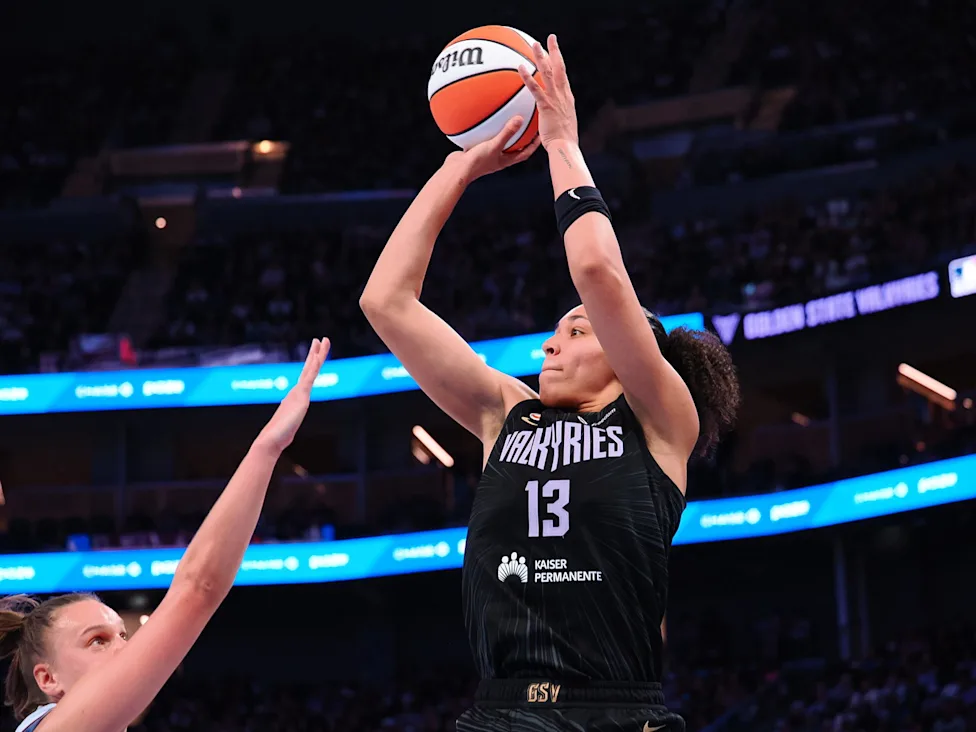
The WNBA isn’t becoming a three-point league. It already is one. The biggest change isn’t simply that players are making more threes. It’s that the three-point shot is changing everything around it — how offenses are built, how defenses rotate, what coaches look for in players, and how teams try to win games when the stakes get higher.
The Golden State Valkyries lead the WNBA with 10.6 three-pointers made per game. The Indiana Fever and the Portland Fire average 10.4 threes per game, with the New York Liberty adding 10.2.
The Three Is Changing the Game
The easiest way to understand the importance of three-point shooting is to forget the three itself. Think about what happens when a defense has to respect it. A guard driving toward the basket doesn’t see as many defenders waiting in the paint. A post player gets more room to operate. A cutter has more space. Pick-and-roll coverage becomes more complicated.
That’s why teams aren’t simply searching for players who can shoot 35 or 36 percent from deep. They’re looking for players whose shooting ability changes how opponents defend the entire lineup.
New York, for example, has attempted threes on 43.3 percent of its field-goal attempts in 2026, while Golden State leads the league at 45.0 percent. Portland sits at 43.6 percent. Those numbers show how central the perimeter has become to modern WNBA offenses.
Caitlin Clark Is Part of the Revolution
Few players represent the evolution better than Caitlin Clark.
The Indiana Fever guard has continued to put pressure on defenses from behind the arc while also creating opportunities for teammates. Clark is averaging 22.5 points, 8.4 assists, and 3.6 rebounds per game. But the most important part isn’t simply Clark’s scoring average. It’s where defenses have to pick her up.
Clark’s range stretches beyond the three-point line, well beyond defenders’ traditional comfort zone. That means a screen set several feet beyond the arc can become an offensive weapon. Give Clark too much room, and she can shoot. Chase her aggressively, and she can attack.
Kelsey Mitchell Is Showing Why Efficiency Matters
Clark isn’t the only Indiana guard benefiting from the league’s perimeter evolution.
Kelsey Mitchell remains one of the WNBA’s premier shooting threats. In 2026, Mitchell is averaging 3.0 made threes per game, placing her among the league leaders. She has also reached the 1,000-point mark this season, becoming only the second player in WNBA history to score 1,000 points in a season, according to reporting during the league’s World Cup break.
Mitchell’s presence changes how opponents can defend Indiana’s other players. A defender who leaves her open is gambling. Sometimes that gamble pays off. Sometimes it turns into three points.
Marina Mabrey and the Rise of High-Volume Shooters
Marina Mabrey is another example of how the league is embracing volume from deep. She is averaging 3.3 made three-pointers per game in 2026, tied for the league lead according to current statistics. Rhyne Howard is also at 3.3, while Mitchell is at 3.0 and Clark at 2.9.
Golden State Is the Warning Shot
If one team demonstrates how powerful the three-point revolution can become, it’s Golden State.
The Valkyries lead the league in made threes per game at 10.6 and have made the second-most threes overall. Janelle Salaün has knocked down 92 triples, while shooting 39.7 percent from three coming off the bench.
Golden State doesn’t have to rely on one superstar having a massive scoring night. The three-point threat can come from multiple places.
It also explains why the Valkyries have paired their perimeter attack with an elite defense. The WNBA’s most dangerous teams aren’t necessarily choosing between shooting and defense anymore.
They’re trying to build both.
The Valkyries have made 424 three-pointers this season and lead the WNBA with 10.6 made threes per game. They aren’t just bombing away for its own sake, either. Golden State has paired its perimeter attack with one of the league’s best defenses while sitting at 29-11 heading into the final stretch of the regular season. That is the blueprint modern teams are chasing.
Follow me on X @lsportstakes and read other outstanding articles on Beyond Women’s Sports.